The Dangote Refinery IPO: How the Transaction Actually Works
Part 2 of The Dangote Refinery IPO: What It Means for Africa and You
Editorial status: Transaction details below are presented against the verified position as of 20 September 2026. The public offer was open, but allotment, admission and trading had not yet occurred.
Now, Let's Look at the Transaction
In Part 1, we looked at why the Dangote Refinery IPO matters beyond the refinery itself: the size of the transaction, the rarity of large IPOs in Africa, what it means for ordinary Africans, and the story of the man and business behind it. We also promised to get into the actual mechanics of the transaction. This is where we do that.
The first thing to get clear is that the Dangote Refinery IPO is a primary offer for subscription. In simple terms, the refinery is issuing new shares to investors. This is different from existing shareholders selling their shares to the public. The money raised therefore goes into the company rather than to Dangote Group, Aliko Dangote, NNPC Limited or another existing shareholder.
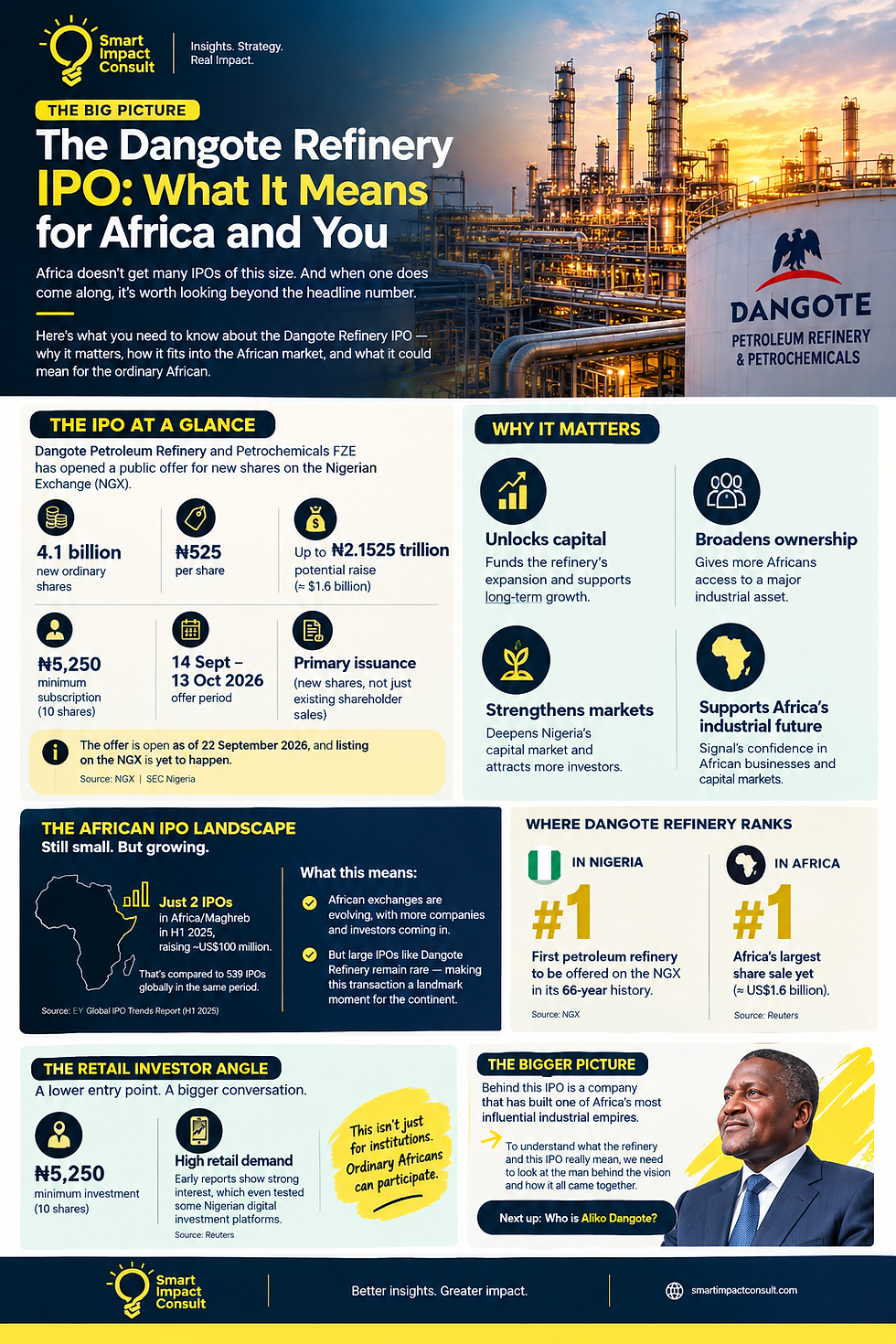
The verified status as at 20 September 2026 was that the IPO had launched and remained open, but the transaction was not yet completed. The offer opened on 14 September and was scheduled to close on 13 October 2026. The shares were not yet allotted and trading on the Nigerian Exchange had not yet commenced. (SEC Nigeria) (Dangote IPO)
So, What Exactly Is Being Offered?
The base offer consists of up to 4.1 billion ordinary shares at a fixed price of ₦525 per share. If the full base offer is subscribed, the gross proceeds would be ₦2.1525 trillion. The prospectus estimates offer expenses of about ₦41.49 billion, leaving approximately ₦2.111 trillion in net proceeds.
For a retail investor, the minimum application is 10 shares, meaning a minimum subscription of ₦5,250. That low entry point is one of the features that has made the transaction so visible beyond traditional institutional investors. The important distinction, however, is that a low entry ticket does not change the nature of the asset. This is equity, and the value of the shares after listing will depend on the company and the market.
The transaction also provides for the possibility of absorbing up to 30% above the base offer, subject to SEC approval. That is an option within the offer structure, not evidence that the IPO had already been oversubscribed as at 20 September. The final amount raised, number of shares allotted and resulting public float therefore could not yet be treated as completed facts at that point.
Official Dangote IPO offer terms and NGX announcement provide the public offer details.
The ₦65.22 Trillion Question
One of the biggest numbers attached to this transaction is the implied equity value of approximately ₦65.22 trillion at the ₦525 offer price. That figure comes from applying the offer price to the enlarged share count after the base offer. It is an implied offer valuation, not a market-tested valuation.
That distinction matters. As at 20 September, the refinery had not yet begun trading on the NGX, so there was no secondary-market share price against which the offer valuation could be tested. The eventual trading price may be above or below the offer price. The ₦65.22 trillion figure therefore tells us what the company is being valued at within the offer structure, not what the market has already decided it is worth.
This is one of the most important numbers to read carefully in the entire transaction. A headline valuation can look definitive, but until the shares trade, it remains an offer-based valuation. (NGX)
Where Does the Money Go?
Because this is a primary issuance, the net proceeds are intended for the refinery's growth capital programme. The transaction documents link the capital raised to the company's expansion plans, with the refinery targeting an increase in refining capacity from 700,000 barrels per day to 1.4 million barrels per day by 2029. The wider expansion programme is budgeted at approximately $14.3 billion, with the balance expected to come from internal cash generation and debt facilities.
This is therefore not simply a case of putting an existing industrial asset into public ownership. The IPO is also a capital formation exercise for the next stage of the business. Investors are being asked to participate in a company that is raising fresh equity to fund expansion.
The IPO Did Not Happen in Isolation
There is another transaction that needs to be kept separate from the public IPO. Before the public offer, the refinery completed a private placement of approximately $2.50 billion in two tranches, with the shares fully allotted by 7 August 2026. That was an institutional transaction. The September public offer is a different transaction with a different investor base and a different mechanism.
The distinction is important because it is easy to combine the two numbers and describe them as one IPO. They are not. The private placement had already been completed, while the public IPO was still open as at 20 September. Keeping the two transactions separate gives a much clearer picture of how the refinery has been sequencing its capital raising.
Who Is Putting the Transaction Together?
Vetiva Advisory Services Limited is identified as the lead issuing house, supported by a syndicate of joint issuing houses. The prospectus also identifies Coronation Registrars as registrar, KPMG Professional Services as reporting accountant and Deloitte & Touche as auditor, alongside legal advisers to the issuer and the offer.
For investors, these names are more than transaction footnotes. An IPO of this scale requires an institutional framework around the issuer, the offer, the applications, the prospectus, the allotment process and eventual admission to trading. The structure is designed to move the transaction from a private industrial asset into a publicly traded security through the Nigerian capital market.
What Happens After the Offer Closes?
This is where the word “IPO” can create confusion. Opening an IPO is not the same thing as completing it. Once the subscription window closes, the process moves into application review, allotment and the steps required for admission to trading.
The verified research available as at 20 September recorded an indicative timetable under which the proposed basis of allotment would proceed for SEC consideration, followed by admission to the NGX Main Board. The exact listing date had not been fixed at that point, and the issuer's timetable continued to treat listing as to be confirmed.
That means any article, social media post or conversation describing the refinery as already listed as at 20 September would be getting ahead of the evidence. The more accurate description was simple: the IPO had launched and was open; the listing was still pending.
SEC Nigeria investor notice and the live Dangote IPO timetable provide the relevant public status information.
And What Does This Mean for Someone Considering the Shares?
This is where the transaction deserves to be viewed with a little more discipline than the excitement around its size might suggest. The ₦5,250 minimum makes participation accessible, but accessibility should not be confused with simplicity. A shareholder is buying an equity interest in a large industrial business whose future performance will depend on operating performance, refining economics, capital expenditure, governance, market conditions and other factors set out in the prospectus.
The offer also creates only a relatively small public float under the base structure, approximately 3.30% of the enlarged shares if the full 4.1 billion share offer is completed. Existing ownership therefore remains concentrated. The IPO creates public participation, but it does not mean control of the company is being broadly dispersed.
There is another important point. SEC approval of the offer is regulatory clearance to conduct the transaction. It is not an endorsement of the investment or a guarantee of future performance. The SEC itself has advised prospective investors to read the approved prospectus, use only authorised subscription channels and understand the terms, conditions and risks before applying.
SEC Nigeria provides the regulator's investor guidance.
The Bigger Capital Markets Story
Perhaps the most interesting part of this transaction is therefore not simply the amount of money involved. It is what the transaction is testing: whether a large African industrial asset can move from concentrated private ownership into the public market, raise substantial domestic capital and create a functioning secondary market around the asset.
For Nigeria, that makes the transaction relevant beyond the refinery itself. For Africa's wider capital markets, it creates a reference point for what large-scale domestic equity mobilisation can look like when a company, regulators, advisers, institutional investors and retail investors meet around one transaction.
And for ordinary investors, the lesson is equally straightforward. Owning a share in a landmark company can be meaningful, but understanding exactly what is being bought, how the transaction works, where the capital is going and what remains uncertain is just as important as being able to afford the minimum subscription.
So, What Comes Next?
Part 1 gave us the why: why the Dangote Refinery IPO matters to Africa, why the rarity of large IPOs makes it worth watching, and who is behind the company. Part 2 has now taken us into the how: the new shares being issued, the ₦525 offer price, the capital being raised, the implied valuation, the expansion programme, the institutional architecture and the steps still standing between an open offer and a listed security.
The next part of the story is not simply whether the transaction makes headlines. It is what the market does with it. Once the offer closes, allotment is completed and the shares begin trading, the public market will start providing the evidence that an IPO prospectus cannot provide on its own: a live price, real liquidity and the market's continuing assessment of the business.
For now, the verified position is clear: the Dangote Refinery IPO had launched and was open as at 20 September 2026; the listing itself was still pending. That distinction is the starting point for understanding what happens next.



Comments